

Cordierite ceramic offers a lower-cost alternative to higher-end materials while still exhibiting similar properties, such as excellent thermal shock resistance, high mechanical strength, good wear resistance, and electrical insulation.
Cordierite ceramic is renowned for its resistance to thermal shock, primarily due to its low thermal expansion. It is widely used in kiln furniture (mats, racks, props, supports, trays, holders, pendants, burner nozzles, and many other shapes) across many industries.
Advantages of cordierite: excellent thermal shock resistance, good high temperature stability, good electrical insulation properties and low thermal expansion.
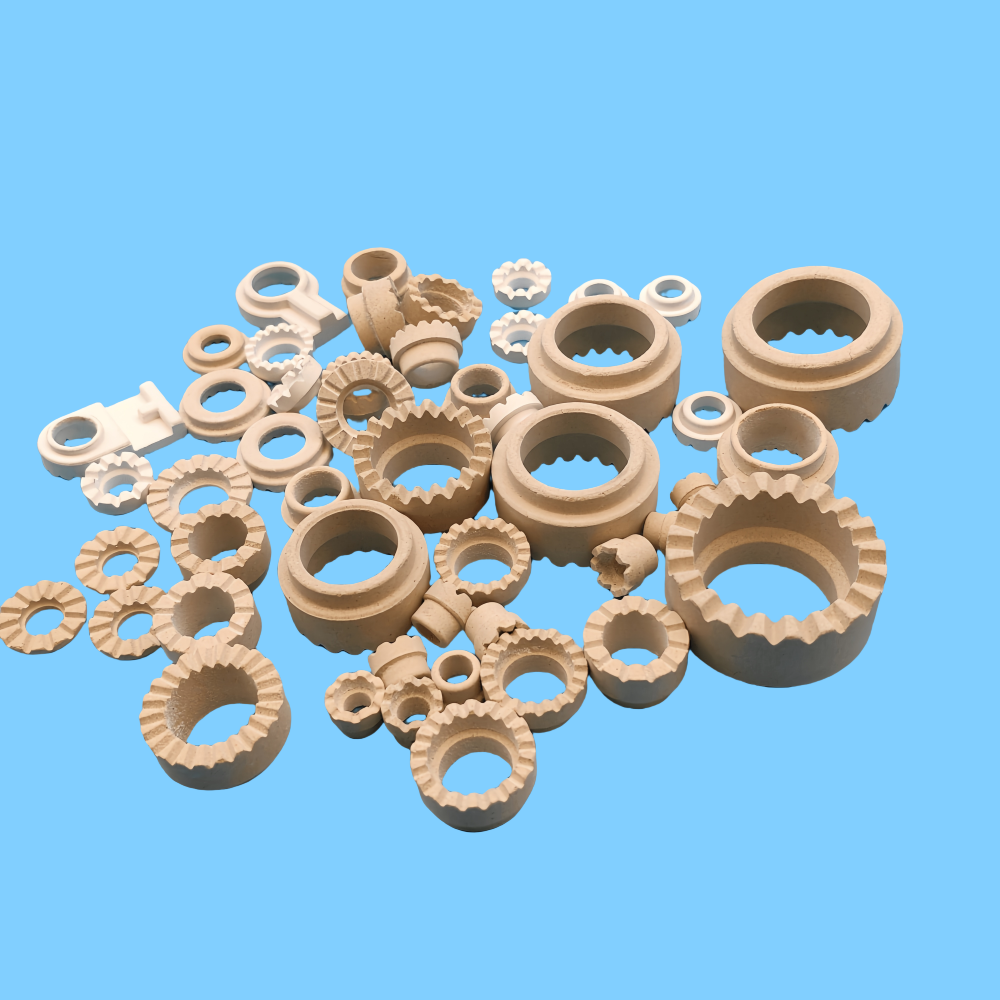
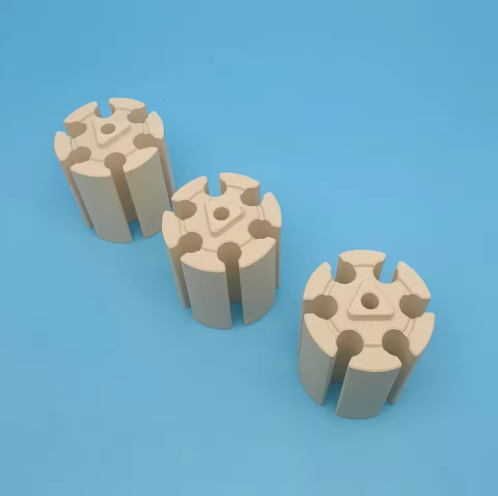
Key Advantages of Cordierite Ceramics
1. Extremely Low Thermal Expansion
* Cordierite has one of the lowest coefficients of thermal expansion (CTE: 1–3 × 10⁻⁶/°C) among ceramics.
* Resists cracking under rapid heating/cooling, making it ideal for thermal shock-prone environments.
2. Superior Thermal Shock Resistance
* Can withstand repeated temperature cycling (e.g., sudden heating from room temperature to 1000°C without cracking).
* Used in kiln furniture, catalytic converters, and cookware.
3. High-Temperature Stability
* Maintains structural integrity up to 1200–1400°C (depending on purity).
* Suitable for furnace components, heat exchangers, and exhaust systems.
4. Good Electrical Insulation
* High dielectric strength and low dielectric loss, useful in electronics and insulating substrates.
5. Chemical Resistance
* Resistant to acids, alkalis, and molten metals (except strong hydrofluoric acid).
* Used in chemical processing and molten metal handling.
6. Lightweight & Low Density
* Lower density (~2.5 g/cm³) compared to alumina or zirconia, beneficial for automotive and aerospace applications.
7. Porous Structure (When Engineered)
* Can be manufactured with controlled porosity for filtration, catalyst supports, and diesel particulate filters (DPF).